Lima With Kids Guide
Lima works best for families who treat the city as a collection of manageable neighborhoods rather than one enormous checklist. Base yourself near the places you expect to visit, leave room for traffic, and balance sightseeing with open-air time. Miraflores is especially practical for coastal outings, while Barranco and the Historic Centre can be planned as separate excursions.
Children can enjoy bicycle outings along the coastal boardwalk, beginner surf activities, neighborhood walks, and indoor entertainment such as cinemas, bowling, food courts, and children’s games. Current availability, age rules, and prices vary, so confirm activity details directly before promising young travelers a particular plan.

Miraflores, Barranco & San Isidro - Districts Tour (Small Group)
Discover the most beautiful and iconic areas of Lima in one unforgettable tour. Visit an ancient archaeological site that reveals the city’s pre-His...

Lima Half-Day City Walking Tour (Small Groups)
Discover the city of Lima known as the "City of Kings"! We will visit the highlights of the Historic Center of Lima...

Private Historic Lima & Larco Museum
If you enjoy architecture and history and are limited on time, this is the tour for you! From grand plazas, palaces...

Lima Airport Private Transfer to Miraflores & Barranco
Your driver meets you at the arrivals gate holding a sign with your name — Gate 9 for domestic flights, Gate 3 for...
- Choose accommodation near your main family activities to reduce cross-city travel.
- Keep one major outing and one flexible activity in each day.
- Use the airport bus when staying near a served Miraflores stop and traveling light.
- Consider an authorized airport taxi for a direct trip with luggage or a stroller.
- Build extra time around Historic Centre visits and other cross-city journeys.
- Confirm current schedules, admission details, age limits, and accessibility before visiting individual attractions.
A successful family day in Lima often has three parts: an active morning, a long meal or rest period, and a short late-day outing. This rhythm limits unnecessary travel and gives younger children space to reset. It also makes the itinerary easier to adjust when traffic, energy levels, or activity schedules change.
Is Lima a good destination for families?
Lima can be a rewarding family destination when the itinerary emphasizes neighborhoods, food, coastal space, and cultural stops instead of constant movement. The city offers a useful mix of outdoor and indoor possibilities. Families can pair a boardwalk outing with a relaxed meal, or follow a historic visit with an easy afternoon near their hotel.
The main limitation is travel time between districts. Congestion-management measures in central Lima show why tightly timed cross-city connections are risky. Avoid stacking reservations in distant neighborhoods, particularly when traveling with toddlers, grandparents, or anyone who needs regular breaks.
A three-day visit can introduce the coast, historic Lima, and another neighborhood without rushing. Families planning a longer stay can slow the pace further. The published 3 Days in Lima Itinerary offers a broader framework that parents can simplify by removing late evenings and limiting each day to one part of the city.
Where to stay in Lima with children
Choose your base according to the family’s daily routine, not simply the number of attractions nearby. A walkable route to meals and a short return to the room can matter more than saving a little time on one sightseeing trip. Check room layout, lift access, breakfast arrangements, and any crib or extra-bed request before booking.
Miraflores for coastal activities and airport bus access
Miraflores is a practical candidate for families interested in the coastal boardwalk and bicycle outings. It is also the district served by the airport’s official Airport Express route. Stops include the Larcomar and Marriott area, the tourist information center on Avenida Larco, Kennedy Park, and Hotel Boulevard.
Before selecting a hotel, compare its location with the activities you actually want to do. The Miraflores Lima Travel Guide can help families understand the district, while Where to Stay in Lima for First Timers provides a broader comparison of possible bases. A central-looking pin is less useful if every family meal still requires a vehicle.
Barranco as a focused neighborhood visit
Barranco is best treated as its own neighborhood outing unless your family chooses to stay there. Plan a compact walking route, stop when children lose interest, and avoid attaching another distant district to the same half-day. The Barranco Neighborhood Guide provides a focused introduction to its streets, murals, mansions, and Bridge of Sighs.
The Historic Centre requires more timing flexibility
The Historic Centre deserves a separate time block with a generous transport buffer. Central corridors can experience congestion controls, and temporary vehicle restrictions can be introduced during security-sensitive events. Check municipal and transport updates near the date of your visit rather than relying on an old route plan.
Families who want a structured introduction can use the Historic Centre of Lima Guide to decide what deserves priority. Keep the route short for young children, agree on a meeting point for older children, and preserve enough time to return without racing toward a reservation in another district.

All-Inclusive Highlights of Lima Tour
This tour is special because in around 8 hours you will have the opportunity to explore the most beautiful places of...

Lima by night including Catacombs & Water Show Tour
On this night visit, you will get to learn about local life in Lima but also about the history of our beautiful coun...

Bean-to-Bar Chocolate Workshop in ChocoMuseo Lima Miraflores
Learn how to make your own chocolate on a 2-hour workshop at the ChocoMuseo in Lima. This is a hands-on activity, st...
Getting from Lima airport to your family accommodation
The practical choice is between the official airport bus and an authorized taxi. The bus suits families staying near one of its Miraflores stops, particularly when luggage is manageable. A taxi provides a more direct journey for accommodation outside the served area or for families carrying bulky bags, a travel cot, or a stroller.

| Airport option | Best suited to | Important detail |
|---|---|---|
| Airport Express Lima | Families staying near a listed Miraflores stop | The official route serves four Miraflores-area stops. |
| Authorized airport taxi | Families staying elsewhere or carrying bulky gear | A direct trip avoids transferring between the bus stop and accommodation. |
| Airline-arranged assistance | Travelers requiring support throughout the airport | End-to-end assistance should be arranged with the airline. |
The airport publishes an Airport Express fare of S/20 for one passenger and an offer of S/15 per person for groups of two or more. Because fares and promotions can change, check the current amount before travel. Calculate the family total, then compare it with the convenience of reaching the hotel directly.
The Lima Airport to Miraflores Transportation Guide provides a fuller comparison for arrivals in that district. Whatever option you choose, keep the accommodation address accessible offline and use transport operating through the airport rather than making an improvised decision while managing tired children and luggage.
Family and accessibility support at the airport
Jorge Chávez International Airport lists family bathrooms, baby strollers to borrow, wheelchairs to borrow, ramps, tactile routes, Braille signage, alternative elevators, priority flows, and electric carts among its free support facilities. Travelers needing assistance throughout the airport journey should arrange it with their airline in advance.
Borrowed equipment should not be treated as a replacement for any mobility aid or stroller your child requires at the destination. Families with specific accessibility needs should also confirm hotel access and transport arrangements separately, since airport facilities do not establish what is available elsewhere in Lima.
Family-friendly activities that fit a flexible itinerary
Walk or cycle along the Miraflores coast
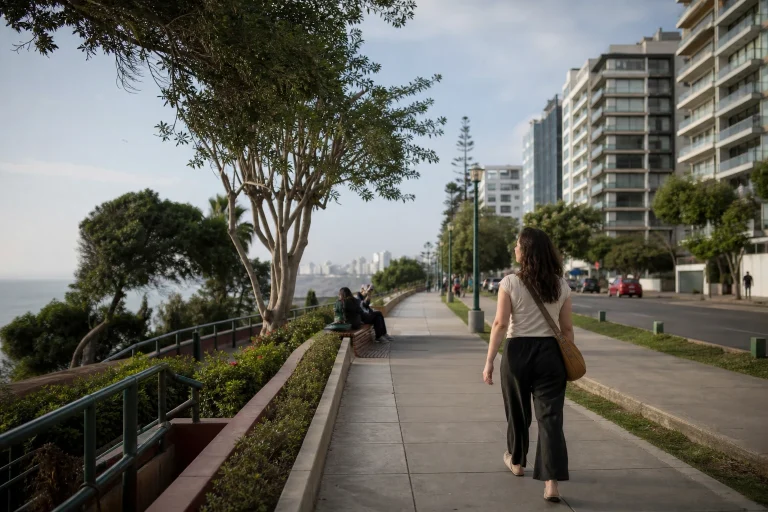
A coastal outing gives children room for movement without committing the entire family to a long indoor visit. Peru tourism material highlights the Miraflores boardwalk as part of a bicycle outing between San Isidro and Barranco. Select a manageable section rather than assuming every child will enjoy the complete route.
For cycling, check the current operator’s child equipment, helmet provision, route rules, and minimum age. Walkers can use the same general idea without reserving equipment. Turn around while everyone still has energy, especially if the return journey includes an uphill connection or another form of transport.
Consider a surf lesson only after checking current age rules
Costa Verde surf schools have been promoted as offering lessons suitable for children, but current operators, age limits, schedules, and conditions must be checked directly. Ask about supervision, equipment, lesson format, swimming expectations, and cancellation procedures before booking. A surf session should be the main activity for that part of the day, not a rushed add-on.
Keep an indoor backup for low-energy periods
Shopping centers can provide cinemas, bowling, food courts, and children’s games, making them useful as flexible indoor options. Facilities differ by location and can change, so choose a specific venue only after checking its current listings. This is especially helpful when the family needs an uncomplicated meal and an activity in the same place.
Still comparing Lima With Kids Walking Tour?
Ask for tour ideas, hotel suggestions, or a simple trip plan that combines both.
Trip Helper
Use major cultural sights selectively
Older children may enjoy archaeology or a short museum visit more than a full day of general sightseeing. The Huaca Pucllana Lima Guide can help parents assess one prominent archaeological stop before committing. Check current admission, tour language, age policies, accessibility, and reservation requirements through the attraction’s own channels.
Give children a simple mission such as choosing one object to remember or asking one question. Leave before concentration collapses, then follow the visit with food or outdoor time nearby. A successful forty-minute stop can create better memories than a longer visit that continues only because the adults paid for it.
Moving around Lima with children
Transport decisions should account for crowd tolerance, luggage, stroller size, and the number of transfers. Lima Metro Line 1 carries more than 600,000 users daily, confirming its importance as a formal transport option. That volume also means it can be an uncomfortable choice for families with bulky gear or children who struggle in crowds.
A door-to-door vehicle can simplify some journeys, but congestion still affects timing. Avoid booking an attraction immediately after a cross-city trip. The Lima Safety And Transport Tips guide covers taxis, city logistics, and first-time transport decisions in more depth.
- Group each day’s activities within one district or a small neighboring area.
- Add a generous buffer before timed admission or a meal reservation.
- Carry only the stroller or child equipment needed for that outing.
- Save the accommodation address and an agreed meeting point offline.
- Check current traffic or access notices before visiting central Lima.
Safety habits for a family trip
Use established tourist routes, stay aware during transfers, and decide how family members will respond if separated. Peru’s Tourist Protection Network identifies 10 tourist corridors in Lima with monitored and patrolled principal routes. No corridor is risk-free, so ordinary city precautions still matter.

The free Tourist Police Perú Android app can be used to request support. Families should also retain another way to seek assistance in case a phone is unavailable. Older children can carry the accommodation name and a guardian’s contact details, while adults can keep copies of essential travel information separate from the originals.
Crowded transport deserves a simple family rule: board and exit together, and do not rush closing doors. Keep small children close and avoid spreading essential items across several bags. If a route feels too crowded for the stroller or luggage, wait for a better option rather than forcing the journey.
A realistic three-day Lima family itinerary
Day 1: Arrive and settle into Miraflores
Choose the official airport bus if your accommodation is near a served Miraflores stop and your bags are easy to manage. Otherwise, use an authorized airport taxi for a direct arrival. After check-in, keep plans modest: eat nearby and take a short walk only if the family still has energy.
Day 2: Coast and one optional activity
Spend the active part of the day on a manageable section of the Miraflores boardwalk. Choose walking, cycling, or a prearranged surf activity according to the children’s ages and confidence. Leave the second half of the day open for a meal, rest, or an indoor entertainment option.

Lima Bike Tour in Miraflores & Barranco - Shared small group
Discover the most touristic districts of Lima by bike: Miraflores & Barranco. On this adventure you will be able to...

Private Full-Day Best of Lima Tour
For the traveler who only has one day to spare in the capital city, this is the perfect tour for you! We'll cover al...

Tour to the Archaeological Sanctuary of Pachacamac (small group)
We will visit one of the most important ceremonial centers on the South Coast of Lima, the Sanctuary of Pachacamac...
Day 3: Historic Lima or Barranco
Pick one neighborhood rather than combining both. Choose the Historic Centre for an architecture and history focus, allowing extra travel time and checking current access updates. Choose Barranco for a compact neighborhood walk. Return to your base before adding another activity, then decide if the family wants a final meal out.
What to pack for exploring Lima as a family
Pack for mobility rather than every possible problem. A compact day bag is easier to manage in vehicles and crowded spaces. Bring routine child supplies, necessary medication, water, a small snack, a portable charger, and an extra layer appropriate to the day’s conditions. Add sun and rain protection according to the forecast at travel time.
- A compact stroller or carrier suited to your child’s needs
- A refillable water bottle and familiar snack
- Necessary medication and a small basic care kit
- A portable charger and offline accommodation details
- A light extra layer plus forecast-appropriate weather protection
- One simple activity for queues or traffic delays
Do not depend on borrowed airport strollers for the wider trip. If a child needs specialized mobility equipment, bring the appropriate aid and arrange airline assistance in advance. Confirm accessibility separately with accommodation, transport providers, and any attraction central to the itinerary.
How to keep the family budget under control
Start with the fixed costs of accommodation and airport transport, then set separate daily allowances for food, local travel, and paid activities. Compare the airport bus total for the whole family with the value of a direct taxi. The least expensive individual fare does not always produce the easiest family journey.

Reserve only activities that define the trip, and keep the rest flexible. Walking the boardwalk or exploring a compact neighborhood can balance a paid surf lesson, museum, or guided visit. Before booking, check what the price includes, the cancellation terms, age rules, and whether transport is part of the package.
A family plan that leaves room for Lima
Lima suits families who enjoy combining food, neighborhood exploration, coastal activity, and selected cultural stops. Its main planning challenge is the time and energy required to cross the city. Choose a convenient base, group outings by area, and avoid measuring a successful day by the number of attractions completed.
Begin with accommodation and airport transport, then select one priority activity for each full day. Confirm the operational details of individual attractions shortly before visiting. With a flexible schedule and realistic expectations, parents can give children a vivid introduction to Lima without turning the trip into a race across the capital.
Frequently asked questions
What is the best area to stay in Lima with kids?
Miraflores is a practical option for many families because it provides access to the coastal boardwalk and the official airport bus stops. The best choice still depends on your planned activities, room needs, and preferred daily travel time.
How should a family travel from Lima airport to Miraflores?
Use Airport Express Lima when your accommodation is near one of its Miraflores stops and your luggage is manageable. An authorized airport taxi is more direct for bulky gear, young children, or accommodation away from the bus stops.
Does Lima airport provide strollers or accessibility assistance?
Yes. The airport lists baby strollers and wheelchairs to borrow, family bathrooms, ramps, tactile routes, alternative elevators, priority flows, and electric carts. Arrange end-to-end assistance with the airline before travel.
What can children do in Miraflores?
Families can consider walking or cycling along the coastal boardwalk, checking current surf lesson options, or using indoor entertainment such as cinemas, bowling, food courts, and children’s games. Confirm current operators, schedules, age rules, and prices before visiting.
Is the Lima Metro suitable for families?
The metro is a major formal transport option, but it can be challenging with a stroller, several bags, or children uncomfortable in crowds. Line 1 carries more than 600,000 users daily, so families should consider crowd tolerance and transfer requirements.
How many days should a family spend in Lima?
Three days can introduce the coast, one historic or cultural area, and another neighborhood at a manageable pace. Extra days allow longer rest periods and reduce the need to cross the city repeatedly.
Should families visit the Historic Centre of Lima?
Yes, if history and architecture interest the family, but plan it as a separate outing with extra transport time. Check current municipal and transport updates because temporary access changes can occur during major events.
Is Lima safe for family travel?
Families should use established routes, remain alert during transfers, and agree on a separation plan. Lima has 10 tourist corridors with monitored and patrolled main routes, and the Tourist Police Perú Android app can be used to request support, but no area is risk-free.
Lima Half-Day City Walking Tour (Small Groups)
Discover the city of Lima known as the "City of Kings"! We will visit the highlights of the Historic Center of Lima such as the Plaza de Armas, the Ca...
Private Historic Lima & Larco Museum
If you enjoy architecture and history and are limited on time, this is the tour for you! From grand plazas, palaces...
Miraflores, Barranco & San Isidro - Districts Tour (Small Group)
Discover the most beautiful and iconic areas of Lima in one unforgettable tour. Visit an ancient archaeological site...
Lima Airport Private Transfer to Miraflores & Barranco
Your driver meets you at the arrivals gate holding a sign with your name — Gate 9 for domestic flights, Gate 3 for...