Historic Centre of Lima Guide
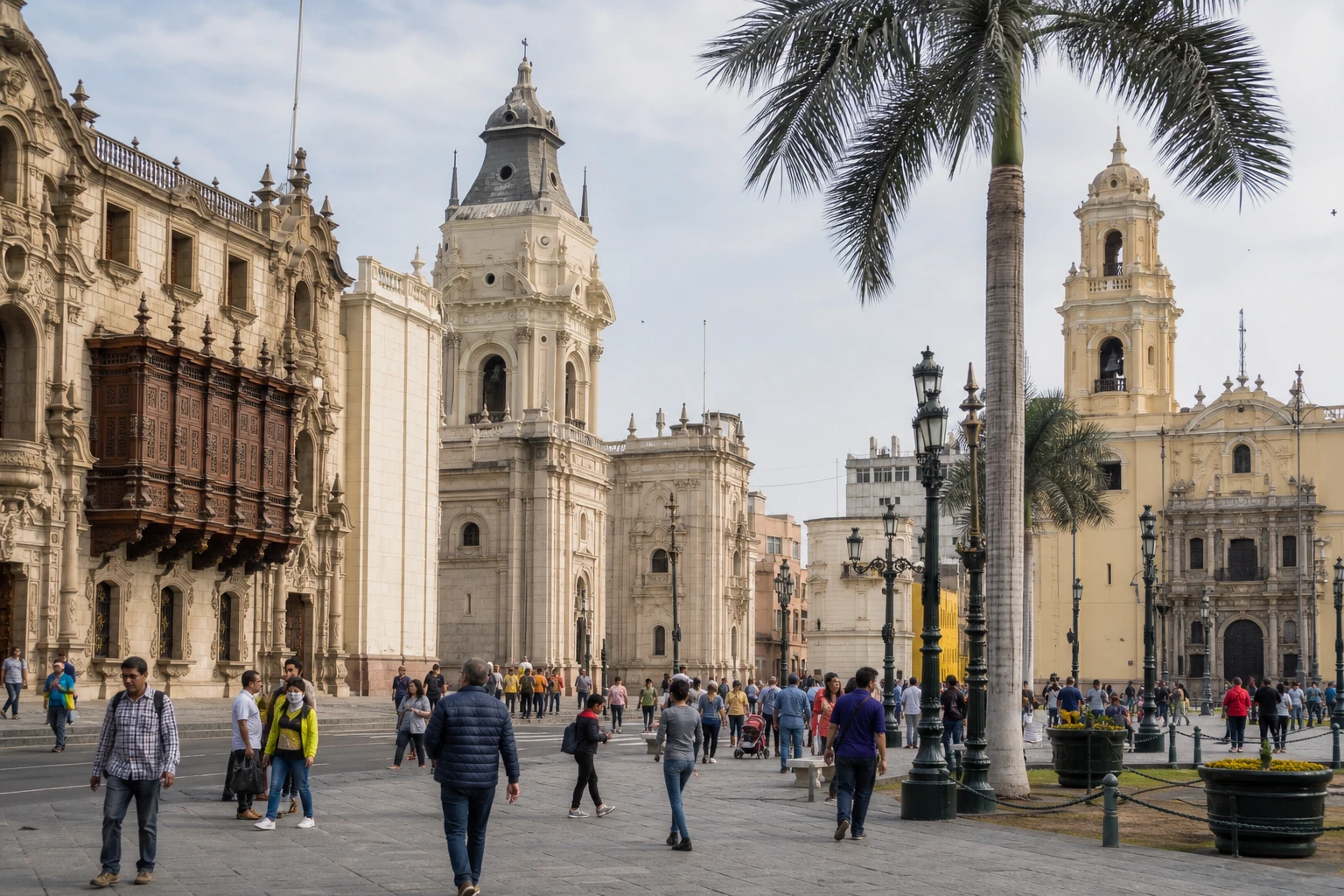
Lima’s historic centre places grand civic and religious architecture inside a working urban district. Its streets preserve the imprint of the city’s role as the political, administrative, religious, and economic capital of the Viceroyalty of Peru. They also carry traffic, commerce, public activity, and the daily pulse of central Lima. A rewarding visit begins with the right expectation: this is living heritage, not a sealed historical park.
Historic Centre of Lima at a glance
- Treat the centre as a broad urban district rather than one attraction with a single entrance, ticket, or schedule.
- Choose a few priority buildings and verify their opening hours and admission arrangements individually.
- Allow extra time between stops because traffic, commercial activity, street controls, and busy crossings can slow movement.
- Check current municipal conditions shortly before visiting, especially if public gatherings or policing operations are reported.
- Confirm accessibility directly with each venue instead of assuming that one accessible stop means the full route is step-free.
- Use a point-to-point walking plan and keep optional stops ready in case access changes.
The UNESCO World Heritage property includes heritage in both Lima and Rímac, including the Convent Ensemble of San Francisco. That scope matters when planning. A map label for the historic centre does not represent one compact compound that can be crossed on a fixed schedule. Focused route planning will usually be more useful than trying to cover every corner.
Why the historic centre matters
UNESCO describes the historic centre through its former position at the heart of the Viceroyalty of Peru. That history helps explain the concentration of colonial-era civic and religious architecture. Instead of viewing each façade in isolation, watch how institutions, public spaces, and religious complexes relate to one another across the central streets.
The Convent Ensemble of San Francisco is explicitly included in UNESCO’s description of the property. It can therefore serve as a useful anchor when building a short list of priorities. Check its current visitor arrangements before departure, since the evidence does not support publishing fixed hours, admission costs, or entry procedures here.
The centre’s atmosphere comes partly from the tension between preservation and ordinary city life. Historic architecture shares space with buses, cars, shops, deliveries, pedestrians, and government activity. UNESCO identifies transport, pollution, and vibration as continuing pressures on the property. The result can feel visually rich and operationally untidy, sometimes within the same block.
How much time should you allow?
There is no evidence-based universal duration for visiting the district. A short visit should concentrate on one connected cluster and perhaps one interior. A longer visit can add several buildings, but only after their schedules are confirmed. Avoid filling the day with tightly timed entries. Street movement may be slower than the map suggests, and individual venues can operate on different schedules.

| Visit style | Best planning approach | Main limitation |
|---|---|---|
| Focused introduction | Select one heritage anchor, one public-space area, and one optional interior | Leaves much of the wider property for another day |
| Half-day exploration | Link several nearby priorities with generous walking buffers | Requires checking every interior separately |
| Flexible extended visit | Combine confirmed entries with outdoor architecture and rest breaks | Traffic and changing local conditions can disrupt a rigid sequence |
Readers who prefer a ready-made sequence can pair this guide with Walking the Historic Center: A Two-Hour Route Through Old Lima. Treat any timed route as a framework rather than a promise. Add breathing room for crossings, photographs, unexpected closures, and the simple temptation to examine another carved doorway.
Build a practical point-to-point route
Begin by choosing the interior visit that matters most to you. Confirm its schedule first, then arrange outdoor stops around that appointment. This method prevents an entire route from depending on an unverified opening time. Keep a second indoor option only if you have also checked its arrangements.
- Mark one priority heritage complex or building as the route anchor.
- Verify that venue’s current hours, admission procedure, and accessibility information.
- Choose a starting point that reduces unnecessary backtracking.
- Add one or two nearby outdoor stops that do not depend on entry.
- Leave a flexible buffer between each planned interior.
- Check same-day municipal conditions before setting out.
San Francisco is a defensible heritage anchor because UNESCO specifically names its convent ensemble within the property. Plaza San Martín is another useful reference point for checking current circulation, although municipal monitoring connected with announced mobilizations has included that area. Do not assume the most direct line between two landmarks will always be the easiest route on the day.
Mercado Central, Mesa Redonda, Triángulo Grau, and Barrios Altos require additional caution in route planning. Municipal and police operations involving commercial premises and freight transport were reported around these areas in May 2026. These should not be treated as frictionless sightseeing corridors. Check current conditions and follow official instructions if your plan takes you nearby.
Still comparing Sightseeing?
Ask for tour ideas, hotel suggestions, or a simple trip plan that combines both.
Trip Helper
Getting there and moving through the centre
The available evidence does not establish reliable current transport routes, fares, transfer times, parking arrangements, or recommended drop-off points. Consult current official transport information or a live navigation service before departure. If arranging a taxi or other door-to-door ride, select a specific, accessible meeting point rather than using “historic centre” as the entire destination.
Once inside the district, think in short segments. Complete one cluster before crossing to another. This reduces backtracking and limits the number of traffic-heavy transitions. It also makes the day easier to adjust if a street becomes crowded or a planned entrance is unavailable.
For broader arrival planning, the site’s Lima Safety, Taxis, and the Coastal Fog: First-Timer Logistics guide covers the subject of city transport and everyday precautions. Recheck its practical recommendations against current official information, since fares, routes, and street conditions can change.
Opening hours, tickets, and reservations
The historic centre has no single centre-wide visitor schedule in the supplied evidence. Churches, museums, government buildings, and other interiors must be checked separately. A building visible from the street may not admit visitors at the time you arrive, and access to an active religious or civic building may differ from ordinary museum entry.

Do not look for one general ticket covering the entire district. No reliable centre-wide admission price was found, and the historic district should not be presented as having a universal entrance fee. Budget venue by venue and verify each cost close to your visit.
| Detail to verify | Why it matters |
|---|---|
| Opening days and hours | Schedules are specific to each building |
| Admission cost | There is no supported centre-wide price |
| Reservation requirement | Entry procedures may vary by venue |
| Religious or official use | Visitor access may be affected by building functions |
| Accessibility arrangements | Facilities cannot be assumed across the district |
Save confirmation details where they remain available without mobile service. If information is unclear, plan to appreciate the exterior rather than allowing one uncertain entry to derail the day. Outdoor architecture provides useful continuity between confirmed interiors, though public-space access can still be affected by local operations.
Best time to visit and what to check
The evidence does not support a universal best hour, a dependable crowd pattern, or a season-by-season weather claim. Check the forecast, individual venue schedules, and current municipal notices shortly before leaving. Your best time is the window when the priority building is confirmed open and the route remains comfortable for your group.
Public events and security responses deserve special attention. In April 2026, the Municipality of Lima described the historic centre as an “intangible zone” where marches, demonstrations, and public or political gatherings that jeopardize security or public health are prohibited. A June 2026 notice reported heightened monitoring and patrols connected with announced mobilizations, including around Plaza San Martín and nearby central points.
Those notices do not prove that access will be disrupted on your date. They do show that demonstrations, restrictions, or policing operations may affect circulation even while the centre remains visitable. Check local conditions shortly before departure, avoid active gatherings, and follow directions from authorities on the ground.
Accessibility requires venue-by-venue planning
Accessibility across the historic centre is uneven and should not be assumed. Official material identifies an accessible-tourism pilot for the area, and MUCEN’s visitor information includes an accessibility section. However, the supplied evidence does not confirm continuous step-free routes, accessible restrooms, tactile services, or specific provisions at the major monuments.
Contact each priority venue directly and ask precise questions. Useful details include the entrance used for step-free access, whether assistance must be arranged, the presence of lifts, seating, accessible restrooms, and any route changes within the building. Also ask about the surface and crossing conditions immediately outside the entrance.
- Confirm the exact accessible entrance rather than only asking if a venue is accessible.
- Ask whether every part of the visitor route can be reached.
- Check restroom availability and access before arrival.
- Request information about seating or rest points if needed.
- Prepare an alternative stop in case the surrounding route is unsuitable.
Travelers with limited stamina may benefit from a shorter route with fewer interiors. The district’s traffic and variable pedestrian comfort can make a geographically compact plan feel more demanding than expected. Build pauses into the route and avoid treating every block as interchangeable.
What to bring for a smoother visit
Bring only what supports a flexible urban day. Comfortable footwear, water, a charged phone, offline access to essential confirmations, and a compact weather layer are sensible. Check the forecast before choosing sun or rain protection because the research does not substantiate specific seasonal conditions for this guide.
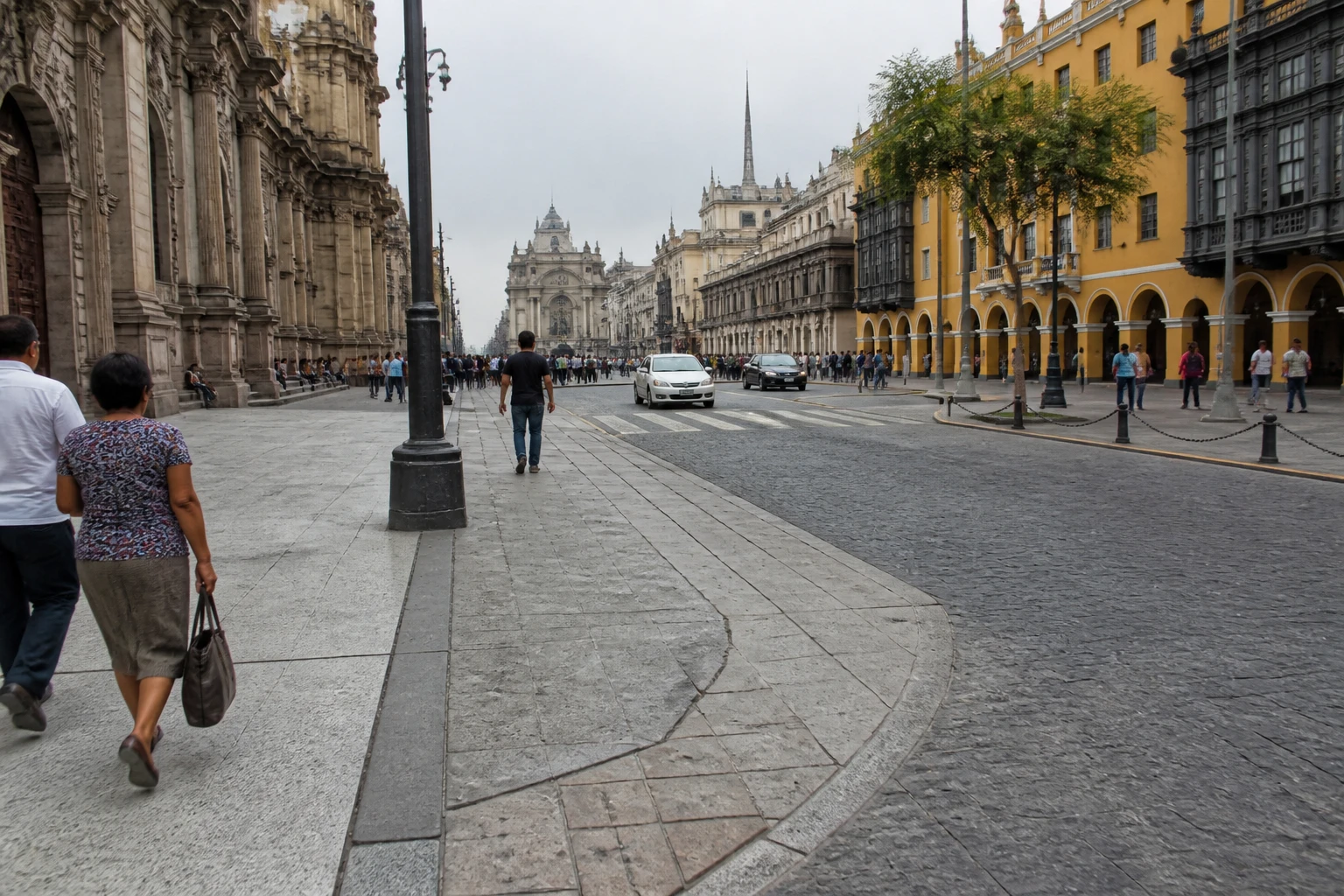
Keep addresses and meeting points written clearly enough to show a driver or official if needed. Store valuables securely and avoid spreading belongings across benches or café tables while reorganizing the route. If the streets ahead look blocked or unusually crowded, pause somewhere appropriate and check current information instead of pressing forward.
Who will enjoy the historic centre most?
The district suits travelers interested in architecture, colonial-era institutions, religious heritage, and the layered geography of central Lima. Its major strength is concentration. Significant civic and religious heritage sits within a connected urban area rather than behind the boundary of a single monument.
The tradeoff is intensity. Visitors should expect a working city centre with transport, shops, public activity, and uneven pedestrian comfort. Someone seeking a calm, controlled museum precinct may find the streets tiring. A traveler who enjoys observing how heritage and modern urban life occupy the same space may find that energy central to the experience.
If this is your first visit to the city, the Complete Guide to Lima for First Timers can help place the historic centre within a wider itinerary. Travelers still choosing a base can also compare the neighborhood options discussed in Where to Stay in Lima: Miraflores, Barranco, or San Isidro?
A simple planning checklist
- Choose one or two priority interiors instead of trying to enter every notable building.
- Verify hours, costs, reservations, and accessibility directly with each venue.
- Arrange outdoor stops around the confirmed interior schedule.
- Choose a precise arrival and departure point using current transport information.
- Check weather and municipal conditions on the day of the visit.
- Keep an alternative route ready and allow extra time for street movement.
A successful day in old Lima depends less on racing between landmarks and more on building a resilient plan. Confirm what can be confirmed, leave room for what cannot, and pay attention to the active city around the architecture. The historic centre rewards curiosity, but it also asks visitors to move with patience.
Frequently asked questions
Is the Historic Centre of Lima a UNESCO World Heritage Site?
Yes. UNESCO lists the Historic Centre of Lima as a World Heritage property. Its scope includes heritage in Lima and Rímac, including the Convent Ensemble of San Francisco.
Does the historic centre have one entrance fee?
No centre-wide admission price was established by the supplied evidence, and the district should not be treated as one ticketed attraction. Verify admission costs separately for each church, museum, or other interior you plan to visit.
What are the opening hours for the Historic Centre of Lima?
There are no supported universal opening hours for the district. Public streets and individual buildings operate differently, so check each church, museum, or government building separately before visiting.
How long should I spend in Lima’s historic centre?
There is no single evidence-based duration. Plan a focused route around one or two priority interiors, then add outdoor stops. Leave extra time because traffic, street activity, and local controls can slow movement.
Is the Historic Centre of Lima accessible?
Accessibility is uneven and must be confirmed venue by venue. Official material acknowledges accessible-tourism efforts, but the evidence does not confirm a continuous step-free route or specific facilities across the main monuments.
Can demonstrations affect a visit?
They can affect circulation. Municipal notices from April and June 2026 described restrictions on certain gatherings and heightened monitoring linked to announced mobilizations. Check current conditions shortly before visiting and follow official directions.
Can I walk through Mercado Central, Mesa Redonda, or Barrios Altos as part of the route?
Do not assume these areas will provide frictionless sightseeing connections. Municipal and police operations involving commercial premises and freight transport were reported around Mercado Central, Mesa Redonda, Triángulo Grau, and Barrios Altos in May 2026. Check same-day conditions before including them.