How to Get Around Lima Without a Car
Getting around Lima without a car is entirely practical, but it rewards a little planning. The city’s transport network includes the Metropolitano busway, complementary bus corridors, airport buses, authorized taxis, and other public services. No single option handles every journey perfectly. The easiest approach is to match each trip with the mode that best fits its route, luggage, time of day, and number of transfers.
- Use the Metropolitano when its dedicated corridor and station locations suit your journey.
- Consider complementary corridors for trips served by their routes, but check the exact fare and payment method first.
- Choose the official airport bus for a direct connection to one of its four listed Miraflores stops.
- Use an authorized airport taxi when carrying substantial luggage or heading somewhere the airport bus does not serve directly.
- Allow extra time for transfers and check ATU service notices before major events.
- Favor identifiable, authorized transport rather than accepting an unverified street or terminal pickup.
The main challenge is not a lack of choices. It is deciding which service fits a particular journey. A dedicated bus corridor can be efficient along its own alignment, while a taxi is more useful for a door-to-door trip. Walking works best for compact local exploration rather than crossing the wider city. Plan the day in geographic clusters and avoid unnecessary backtracking.

Lima City, Central Market & Catacombs Tour (Pick-up & Drop Off)
We pick you up from your hotel to head to Historic Center, where we are starting our walking and first stop will be Central Market where we are learni...

The Original Highlights of Lima - Private Half Day Tour
For the traveler who only has a few hours to spare, this tour, coined "The Perfect Snapshot of Lima" by previous gue...

A Journey Through Time: Lima's Historic Center & Catacombs Tour
⚠️ Important: The price shown corresponds to the ESSENTIAL option. Full experiences such as hotel pickup and tic...

Lima Bike Tour in Miraflores & Barranco - Shared small group
Discover the most touristic districts of Lima by bike: Miraflores & Barranco. On this adventure you will be able to...
Choose transport according to the trip
Start by identifying the nearest useful station or authorized stop at both ends of the journey. If one service covers most of the route, public transport is often the simplest choice. If reaching that service requires several awkward connections, an authorized taxi can reduce friction. This matters especially when you have luggage, an appointment, or limited time between activities.
| Option | Best suited to | Main tradeoff |
|---|---|---|
| Metropolitano | Journeys aligned with its exclusive busway | You must reach a station and may need a transfer |
| Complementary corridors | Trips served by a corridor route | Fare and payment details depend on the exact service |
| Authorized taxi | Door-to-door travel, luggage, or awkward connections | Road traffic can affect the journey |
| Official airport bus | Airport travel to one of four listed Miraflores stops | It does not provide door-to-door hotel service |
| Walking | Short trips within the area you are exploring | Unsuitable for covering long cross-city distances |
A useful daily rhythm is to take public transport for the longer outward journey, explore one district on foot, and use an authorized taxi when the return route is inconvenient. This keeps the plan flexible without making every ride a separate puzzle. Our Lima safety, taxis, and coastal fog guide adds broader first-timer logistics for planning days around the city.
Use the Metropolitano when the corridor matches your route
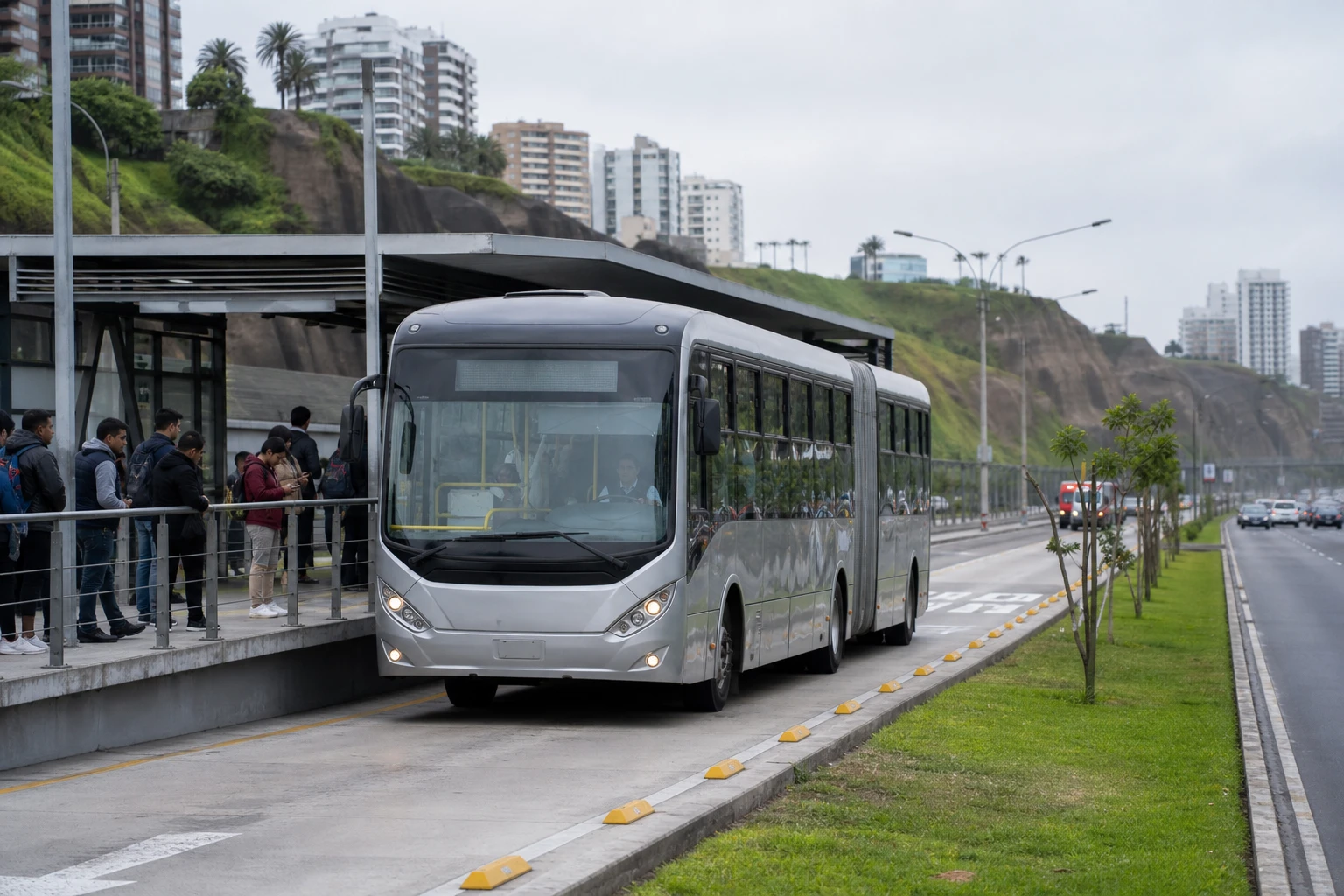
The Metropolitano runs on an exclusive busway, so its vehicles are separated from ordinary mixed traffic along the corridor. That can reduce some road-related delay when the line serves the places you need. The advantage depends on route fit. It is a station-based system rather than a door-to-door service, and reaching the station or completing the final leg can require walking or another connection.
Before setting out, work backward from your destination. Find the station you intend to exit, then confirm how you will cover the final stretch. Repeat the same check for the return journey. A route that looks direct on the main corridor can become less convenient if either endpoint sits far from a useful station.
Stations and vehicles can demand quicker decisions than a private ride. Keep your destination available offline, move away from entrances while checking directions, and have the required payment method ready before joining a boarding flow. If you are carrying bulky bags, consider whether a taxi would make the trip easier for you and everyone around you.
Understand complementary corridors, fares, and transfers
Lima’s complementary corridors can fill gaps that the Metropolitano does not cover. On the Corredor Rojo, ATU publishes a general fare of S/2.43 and a promotional short-trip fare of S/1.20. These are service-specific figures, not universal prices for every bus in Lima, and transport fares can change. Check the current fare for the exact route before boarding.

ATU also lists a two-service integrated Corredor Rojo fare of S/2.43. Published integrated fares are S/3.50 for a connection with Corredor Morado and S/3.60 for a connection with Corredor Azul. The cited transfer window is two hours after the first validation, and the connection must take place at an authorized transfer stop.
Integrated fares are useful only when you follow the eligible connection rules. Do not assume that changing vehicles anywhere will trigger the lower combined fare. Identify the authorized connection stop in advance, note the two-hour window, and avoid turning a straightforward transfer into an improvised detour.
Payment arrangements deserve attention before your first ride. ATU refers to Metropolitano and Lima Pass cards for certain fares and advertises digital card top-ups through Plin and Yape. Card, cash, and app options can differ by service, so verify what the specific route accepts rather than relying on one payment method across the network.

Miraflores, Barranco & San Isidro - Districts Tour (Small Group)
Discover the most beautiful and iconic areas of Lima in one unforgettable tour. Visit an ancient archaeological site...

All-Inclusive Highlights of Lima Tour
This tour is special because in around 8 hours you will have the opportunity to explore the most beautiful places of...
Lima Half-Day City Walking Tour (Small Groups)
Discover the city of Lima known as the "City of Kings"! We will visit the highlights of the Historic Center of Lima...
Get from Lima airport to the city without renting a car
Jorge Chávez International Airport lists Airport Express Lima as its official bus service. It connects the airport directly with four stops in the Miraflores area: Marriott/Larcomar, the Tourist Information Center on Avenida Larco, Kennedy Park, and Hotel Boulevard. The listed fare is S/20 for one passenger or S/15 per person when at least two passengers travel together.
The bus is most convenient when one of those stops is reasonably close to your accommodation. It is not a hotel-by-hotel service, so consider the final connection before choosing it. Check the current departure information after arrival because the airport listing does not provide a journey-time promise suitable for every trip.
For door-to-door transport, use the authorized-taxi counters in the national or international arrivals area. Airport staff direct passengers from those counters to a dedicated airport parking area. This is a clearer and more accountable process than accepting an unverified pickup outside the terminal.
Choose between the official bus and an authorized taxi by considering your destination, luggage, group size, and arrival conditions. The bus offers a direct link to its named Miraflores stops. A taxi is better suited to accommodation elsewhere or a trip where minimizing transfers matters. Our Lima Airport to Miraflores transportation guide provides a focused comparison for that arrival route.
Use taxis selectively and choose identifiable services
Taxis are most useful when public transport does not align with the journey, when you have luggage, or when several connections would consume too much of the day. At the airport, use the authorized counters inside arrivals. Elsewhere, favor a service that can be clearly identified rather than stepping into an unverified vehicle simply because it is nearby.
ATU reported enforcement involving more than 2,400 informal public-transport vehicles during the first half of 2026 and continued to publish enforcement activity in July. This does not mean every informal vehicle presents the same risk. It does support a simple visitor rule: use authorized, identifiable transport and official airport channels.
Before the ride begins, check that the destination is correct and follow the route on your own device when possible. Keep small belongings together so nothing is left behind during a hurried exit. If traveling with companions, agree on the destination before splitting between vehicles.
Plan each day by neighborhood to reduce long transfers
The easiest car-free itinerary groups nearby activities into the same part of the city. Choose one main district or cluster for a half-day, travel there once, and explore locally before moving on. This reduces repeated transfers and makes delays less disruptive. It also leaves more time for street-level details instead of watching the day pass through a vehicle window.

If you are staying in or visiting Miraflores, use our Miraflores Lima travel guide to identify the places you want to group together. For another focused outing, the Barranco neighborhood guide can help you organize a district-based visit before choosing the transport that best reaches your starting point.
Apply the same method to central Lima. Decide what you want to see, select a sensible arrival point, and keep the local portion of the day compact. The Historic Centre of Lima guide can help define that sightseeing cluster. Confirm the return route before setting out so you are not building a new transport plan when tired.
- Choose the day’s main neighborhood or sightseeing cluster.
- Identify the best public-transport station or authorized drop-off point for the first stop.
- Save the destination and return point offline.
- Confirm the fare and payment method for each public service you expect to use.
- Add a fallback option, usually an authorized taxi, for an awkward final connection or changed service.
Still comparing Lima Car Free Transportation And Airport Transfers?
Ask for tour ideas, hotel suggestions, or a simple trip plan that combines both.
Trip Helper
Check service changes before event days
Transport operations can change for major events. For the Lima 42K on May 24, 2026, ATU arranged early service and modified operations. That event plan was exceptional rather than a normal daily timetable, but it illustrates why visitors should check current ATU notices and the relevant operator shortly before traveling on event days.
Build a modest time buffer around airport departures, timed admission, restaurant reservations, and tours. If an event affects your planned corridor, consider leaving earlier or switching to a more direct authorized option. Avoid relying on a special-event schedule after the event has ended.
Save key route details before leaving reliable internet access. A screenshot of the destination name, intended station, transfer point, and accommodation address can be more useful than trying to reconstruct the whole trip beside a busy boarding area. Recheck live notices when connectivity is available.
Plan accessibility needs route by route
Travelers who need step-free access should confirm the exact route, stop or station, vehicle, and boarding process before travel. Do not assume that accessibility conditions are identical across the Metropolitano, complementary corridors, airport buses, or taxis. A workable main route can still fail if one connection lacks the access you need.
For an airport transfer, check accessibility arrangements with the selected bus or authorized-taxi provider before arrival. Include luggage dimensions, mobility equipment, and boarding assistance in that conversation. For city trips, plan both the outward and return legs rather than confirming only the first station.
A simple car-free strategy for Lima
Use the official airport bus when its Miraflores stops fit your arrival plan, or choose an authorized airport taxi for a direct transfer. During the stay, rely on the Metropolitano and complementary corridors when their routes make sense. Explore compact neighborhood clusters on foot, then use an authorized taxi to solve inconvenient connections rather than forcing a complicated chain of transfers.
Lima without a car works best for travelers who are willing to plan each journey rather than search for one universal solution. The main limitation is that station locations, transfers, payment methods, and event changes require attention. Check the day’s route before leaving, keep a backup option, and let each neighborhood provide the slower, more rewarding part of the journey.
Frequently asked questions
Can you get around Lima without renting a car?
Yes. Visitors can combine the Metropolitano, complementary corridors, authorized taxis, airport transport, and walking. The best option depends on whether the route aligns with a public-transport corridor and how many connections are required.
What is the best way to travel from Lima airport to Miraflores?
Use the official Airport Express Lima bus if one of its four listed Miraflores stops suits your destination. Choose an authorized airport taxi for door-to-door travel or accommodation that is inconvenient to reach from those stops.
How much is the official airport bus in Lima?
The airport lists a fare of S/20 for one passenger or S/15 per person when two or more passengers travel together. Fares can change, so check the current listing before travel.
Does the Metropolitano avoid Lima traffic?
The Metropolitano uses an exclusive busway, which separates it from ordinary mixed traffic along its corridor. Its usefulness still depends on whether its stations fit your route and whether you need another connection.
Can visitors pay cash on Lima public transport?
Payment methods depend on the exact service, so do not assume cash will work everywhere. ATU refers to Metropolitano and Lima Pass cards and offers digital top-ups through Plin and Yape for those cards.
Is Lima public transport wheelchair accessible?
Accessibility should be confirmed for the exact route, station, stop, vehicle, and transfer. Travelers needing step-free transport should also check airport-transfer arrangements directly with the selected provider before travel.
Do Lima bus schedules change during major events?
Yes, operations can be modified for major events. Check current ATU notices and information from the relevant operator shortly before travel, especially if road closures or a large organized event are expected.
A Journey Through Time: Lima's Historic Center & Catacombs Tour
⚠️ Important: The price shown corresponds to the ESSENTIAL option. Full experiences such as hotel pickup and tickets to the San Francisco Convent...
Lima City, Central Market & Catacombs Tour (Pick-up & Drop Off)
We pick you up from your hotel to head to Historic Center, where we are starting our walking and first stop will be...
Lima Half-Day City Walking Tour (Small Groups)
Discover the city of Lima known as the "City of Kings"! We will visit the highlights of the Historic Center of Lima...
Lima Bike Tour in Miraflores & Barranco - Shared small group
Discover the most touristic districts of Lima by bike: Miraflores & Barranco. On this adventure you will be able to...