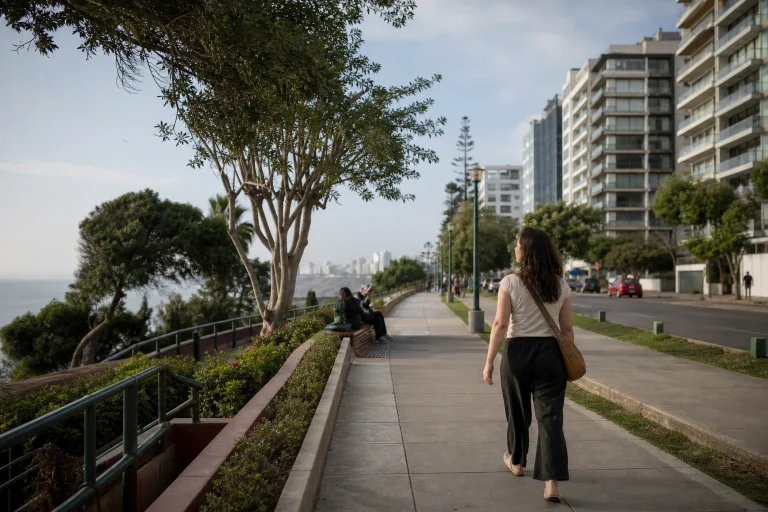
Lima Weather by Month
How to read Lima weather by month
Treat Lima weather by month as a packing and scheduling question. Lima-area coastal conditions can be very humid while recording little precipitation, so a damp feeling or misty view does not automatically call for a heavy-rain plan. The useful approach is to pair a close-to-departure forecast with flexible daily timing and a small set of adaptable layers.
- High humidity and mist do not automatically mean heavy rain is falling.
- Use a near-date forecast to make final decisions about walking time, layers, and the order of your day.
- Avoid relying on unlabeled monthly averages that do not identify a weather station and long-term baseline.
- Keep a buffer around airport transfers because road disruptions are separate from weather conditions.
- Airport Express Lima is identified by Jorge Chávez International Airport as its official public bus service, but check current schedules and fares before travel.
Why humidity and precipitation tell different stories
Humidity affects how the air feels on your skin, while precipitation measures what actually falls. In Lima’s coastal conditions, the two can diverge: the air can feel damp and mist can soften the view even when recorded precipitation remains low. Pack for comfort in humid conditions rather than assuming every gray-looking day needs an umbrella-first itinerary.

Lima City, Central Market & Catacombs Tour (Pick-up & Drop Off)
We pick you up from your hotel to head to Historic Center, where we are starting our walking and first stop will be Central Market where we are learni...

Discover Lima: Love Park, Historic Center, and its Catacombs.
⚠️ Important: The price shown corresponds to the ESSENTIAL option. Full experiences such as hotel pickup and tic...

Magic Water & Laser Light Show Including Pickup And Drop-Off
Experience the Magic Water Circuit, one of Lima’s premier evening attractions. Proudly holding the Guinness World...
Use climate charts with clear labels
A useful month-by-month climate chart should name its observation station, baseline period, and method. An isolated set of daily observations cannot stand in for a 12-month long-term normal. This guide therefore avoids publishing precise monthly highs, lows, rainfall totals, or sunshine figures without that context, and focuses instead on decisions that help on real travel dates.
The 12-month Lima weather planning calendar
The calendar below is deliberately forecast-led. It gives you a practical action for the month of your visit without inventing a hot, cold, wet, or sunny label where a dependable long-term Lima climate dataset has not been provided. Use it to keep daily plans comfortable and easy to adjust.

| Month | Practical weather-planning action |
|---|---|
| January | Check a short-range forecast before placing outdoor plans into fixed time slots. Keep the day’s order easy to swap if conditions feel less comfortable than expected. |
| February | Compare the outlook across the days of your stay before committing to a weather-sensitive activity. Keep one alternative nearby rather than building a rigid schedule. |
| March | Review temperature, humidity, and precipitation together. A rain icon alone does not describe how a humid coastal day will feel. |
| April | Bring layers that work together, then make your final clothing choice on the day. This keeps you prepared without carrying a bulky wardrobe. |
| May | Put your most time-sensitive reservation first, then leave room to rearrange walks, meals, and indoor stops around current conditions. |
| June | Treat mist and precipitation as separate signals. Check the forecast details rather than making a decision from a cloudy-looking icon alone. |
| July | Confirm conditions close to any fixed outdoor booking. Choose an operator or reservation policy that gives your itinerary some room to adapt. |
| August | Use a compact daily plan with a clear backup option. A flexible route is more useful than guessing conditions weeks in advance. |
| September | Refresh the forecast after you arrive, especially before committing to a long day outside. Local conditions matter more than a generic monthly label. |
| October | Keep an outer layer accessible rather than buried in luggage. Comfortable layering is easier than trying to predict every hour in advance. |
| November | Check the day’s forecast before deciding the sequence of outdoor and indoor activities. Reserve rigid timing for experiences that genuinely require it. |
| December | Make one final check before departure and keep the first day light. That leaves space to adjust after the journey and settle into local conditions. |
The repetition is intentional. A visitor traveling in any month benefits more from current, detailed conditions than from a made-up seasonal promise. A forecast-led plan also avoids overpacking: you can make a clear decision about layers and activity order close to the date, then spend the rest of your energy enjoying Lima rather than decoding a questionable weather table.
Set up a forecast routine before each day out
Start checking conditions while your itinerary is still movable, then check again shortly before you leave your accommodation. Look beyond a single summary icon. Temperature, humidity, precipitation details, and any official alerts give a more useful picture of what to wear and how tightly to schedule a walk or timed visit.
- About a week before travel, make a rough daily plan with one priority and one easy alternative for each day.
- A few days before departure, use the forecast to decide which reservations need the most flexibility.
- The evening before, arrange your outer layer, comfortable footwear, water, and any booking confirmations for the following day.
- On the morning itself, make the final call on the order of outdoor and indoor plans.
- If conditions change, shorten the route rather than rushing. A calmer schedule leaves room for a good meal, a museum, or a return to your accommodation.
This routine works especially well for short visits, when every day has weight. Instead of making a different set of assumptions for every month, build an itinerary that can pivot by a few hours. A flexible lunch, an unscheduled neighborhood stroll, or an indoor stop can save a day from feeling overplanned.

Lima by night including Catacombs & Water Show Tour
On this night visit, you will get to learn about local life in Lima but also about the history of our beautiful coun...

The Complete Lima Experience: History, Culture & Flavors
Get the Best of Lima with us! If you have only one day in Lima and want to make the most of it, this is your chance...

Pachacamac Archaeological Complex and Barranco
Begin the tour in Barranco, Lima’s most bohemian suburb. We will see Barranco’s Central Park, its Municipal Libr...
What to pack for humid or misty Lima conditions
Aim for a compact wardrobe that handles a damp-feeling day without making you overheat indoors. The key is adjustment: a breathable base layer, a light insulating layer, and an outer layer you can put on or remove quickly. This is more practical than treating humidity as proof of a rainy day.
- A light outer layer that is easy to carry when conditions change.
- Breathable tops that can be worn alone or layered.
- Comfortable footwear suited to a full day on your feet.
- A small bag with a simple cover or internal pouch for electronics and documents.
- A refillable water bottle for long days out.
- A small amount of spare space in your day bag so you can store an extra layer instead of tying it around your waist.
Keep the packing list tied to your plans. A traveler spending most of the day in museums, restaurants, and taxis needs different flexibility from someone scheduling long walks. Choose clothes that work in both settings, and leave room in your itinerary to return for an extra layer if your accommodation is conveniently located.
Build a resilient airport arrival and departure plan
Do not treat weather as the only factor in an airport transfer. Jorge Chávez International Airport identifies Airport Express Lima as its official bus service and a public-transport option. For a route-specific handoff after landing, the Lima Airport to Miraflores Transportation Guide is useful for comparing the transfer choices that fit your arrival time and luggage needs. Check the operator’s live timetable and fare before committing to a plan.

Road access can be disrupted by demonstrations independently of weather, so leave a sensible time buffer for flights and avoid making a transfer your last-minute task. Use vetted transportation, keep valuables secure, and stay aware after dark. The Lima Safety, Taxis, and the Coastal Fog: First-Timer Logistics guide is a helpful companion for the ground-level decisions that sit alongside weather planning.
The airport provides Braille signage, tactile guidance, ramps, alternative elevators, electric carts, preferential services, free wheelchair loans, and Peruvian Sign Language assistance. These are terminal facilities, not a promise that every street or vehicle in Lima is accessible. Travelers needing assistance throughout the flight journey should arrange it with their airline before travel.
Choose dates and neighborhoods with flexibility in mind
If comfortable conditions are important to your trip, prioritize flexible bookings and avoid building every day around one fixed outdoor commitment. Put your must-do activity on an earlier day when possible. If conditions are not to your liking, you still have room later in the stay to reshuffle a walk, a food stop, or a museum visit.
Keep each day geographically simple
A neighborhood-based plan reduces the pressure to cross the city when you would rather adjust pace or return for a layer. The Miraflores Lima Travel Guide can help shape a district-focused day, while the Historic Centre of Lima Guide supports a walking-centered plan with a clear geographic focus. Save ambitious cross-city movement for the days when your schedule feels settled.
The practical answer for Lima weather by month
Lima weather planning works best for travelers who value adaptable days over rigid predictions. Recognize that humid mist does not equal a rainstorm, pack layers that are easy to adjust, and consult a detailed forecast near your travel date. The main limitation of any month-by-month guide is that it cannot replace current conditions. Choose flexible itinerary pieces, protect your airport buffer, and let the day’s forecast set the final rhythm.
Frequently asked questions
Does Lima’s damp air mean it is raining heavily?
No. Lima-area coastal conditions can feel very humid and misty while recorded precipitation remains low. Check precipitation details alongside humidity before changing a day’s plan.
Why are there no monthly average temperatures or rainfall totals in this guide?
A reliable 12-month climate table needs a clearly named station and long-term baseline. An isolated set of daily observations is not a dependable year-round Lima climate normal.
How far ahead should I check Lima’s weather forecast?
Start checking while your itinerary is still flexible, then review the forecast again shortly before you leave for the day. Use the final check to decide on layers and the order of outdoor plans.
What should I pack for humid and misty conditions in Lima?
Pack breathable clothing, a light outer layer, comfortable footwear, and a small way to protect electronics and documents. Layers are more useful than assuming humid conditions require full rain gear.
Is there an official bus from Jorge Chávez International Airport?
Yes. Jorge Chávez International Airport identifies Airport Express Lima as its official bus service and a public-transport option. Check the operator’s current route, timetable, and fare before you travel.
Is Jorge Chávez International Airport accessible for travelers needing assistance?
The airport lists features including ramps, tactile guidance, Braille signage, accessible elevators, electric carts, free wheelchair loans, and sign-language assistance. Contact your airline ahead of travel for support that extends through the flight journey.
Lima City, Central Market & Catacombs Tour (Pick-up & Drop Off)
We pick you up from your hotel to head to Historic Center, where we are starting our walking and first stop will be Central Market where we are learni...
Discover Lima: Love Park, Historic Center, and its Catacombs.
⚠️ Important: The price shown corresponds to the ESSENTIAL option. Full experiences such as hotel pickup and tic...
Magic Water & Laser Light Show Including Pickup And Drop-Off
Experience the Magic Water Circuit, one of Lima’s premier evening attractions. Proudly holding the Guinness World...